If you work in B2B marketing in Switzerland, you've probably noticed something has shifted in the last twelve months. Inbound leads mention ChatGPT more often than Google. Buyers arrive at sales calls already half-convinced by sources you've never heard of. Your SEO traffic looks fine on the surface, but conversion patterns are changing.
This is not a coincidence. It is the early visible effect of a much bigger change in how B2B discovery works. AI search engines, conversational agents, and procurement copilots are quietly becoming part of the buyer journey. In the DACH region, and in Switzerland specifically, this transition comes with its own characteristics that international playbooks tend to overlook.
The question for Swiss marketing managers is not whether to react. It is how to react in a way that fits the market, the language landscape, and the realistic budgets of mid-market SMEs and scale-ups.
1. The Swiss Context: Why Generic AI Advice Often Misses the Mark
Most of what gets published about AI search and marketing automation assumes a single-language, single-market reality. In Switzerland, that assumption breaks down immediately.
A Swiss B2B company often operates across at least two languages, frequently three or four. Buyers in Zurich research in German or Swiss-flavored High German. Buyers in Lausanne search in French. Buyers in Lugano often blend Italian with English technical terms. International prospects default to English. The same product page can be the right answer in four languages and still rank for none of them if it has been translated mechanically rather than built for each market.
On top of language, there are structural differences. Swiss B2B buying cycles tend to be longer and more relationship-driven. Decision-makers are cautious adopters. Data protection expectations are high, and the proximity to the EU means GDPR considerations sit alongside Swiss FADP requirements. Many SMEs and scale-ups operate with lean marketing teams, often one to five people covering everything from content to events to paid media.
This is the real backdrop against which AI search and AI-driven marketing need to be understood. The opportunity is significant, but it requires an approach designed for the Swiss reality rather than a copy-paste of US or UK best practices.
2. The Shift from Search to Answers
For most of the last two decades, B2B discovery worked roughly the same way. A buyer typed a query into Google, scanned a few results, clicked through to a couple of sites, and slowly built a shortlist. SEO was built around that behavior.
That model is now competing with a new one. A growing share of buyers asks ChatGPT, Perplexity, Claude, or Gemini directly. They receive a synthesized answer, often with three or four named vendors, and skip the browsing stage entirely. By the time they land on your site, the comparison has often already happened.
This has two consequences for Swiss B2B teams.
First, being visible in the AI answer matters as much as being ranked in the traditional results. If your company is not part of the model's synthesized response, you do not exist for that buyer at that moment.
Second, the criteria for showing up in those answers are different. AI systems pull from sources that are structured, consistent, well-cited, and clearly written. They favor content that answers questions directly rather than content that is optimized to keep people on a page. Many Swiss B2B websites are still built for the older model, with marketing-heavy language, vague positioning, and minimal structured information about what the company actually does, for whom, and how.
The shift from search to answers is not a marginal trend. It is a change in the underlying logic of B2B discovery.
3. Multilingual Visibility: The Hidden Bottleneck
The multilingual challenge in Switzerland is often treated as a translation problem. In an AI search world, it is much closer to a strategy problem.
Translating a German page into French does not make it discoverable in French AI answers. AI systems weigh the consistency of terminology, the authority of the source, the structure of the content, and the alignment with how local buyers actually phrase their questions. A literal translation often misses all of this.
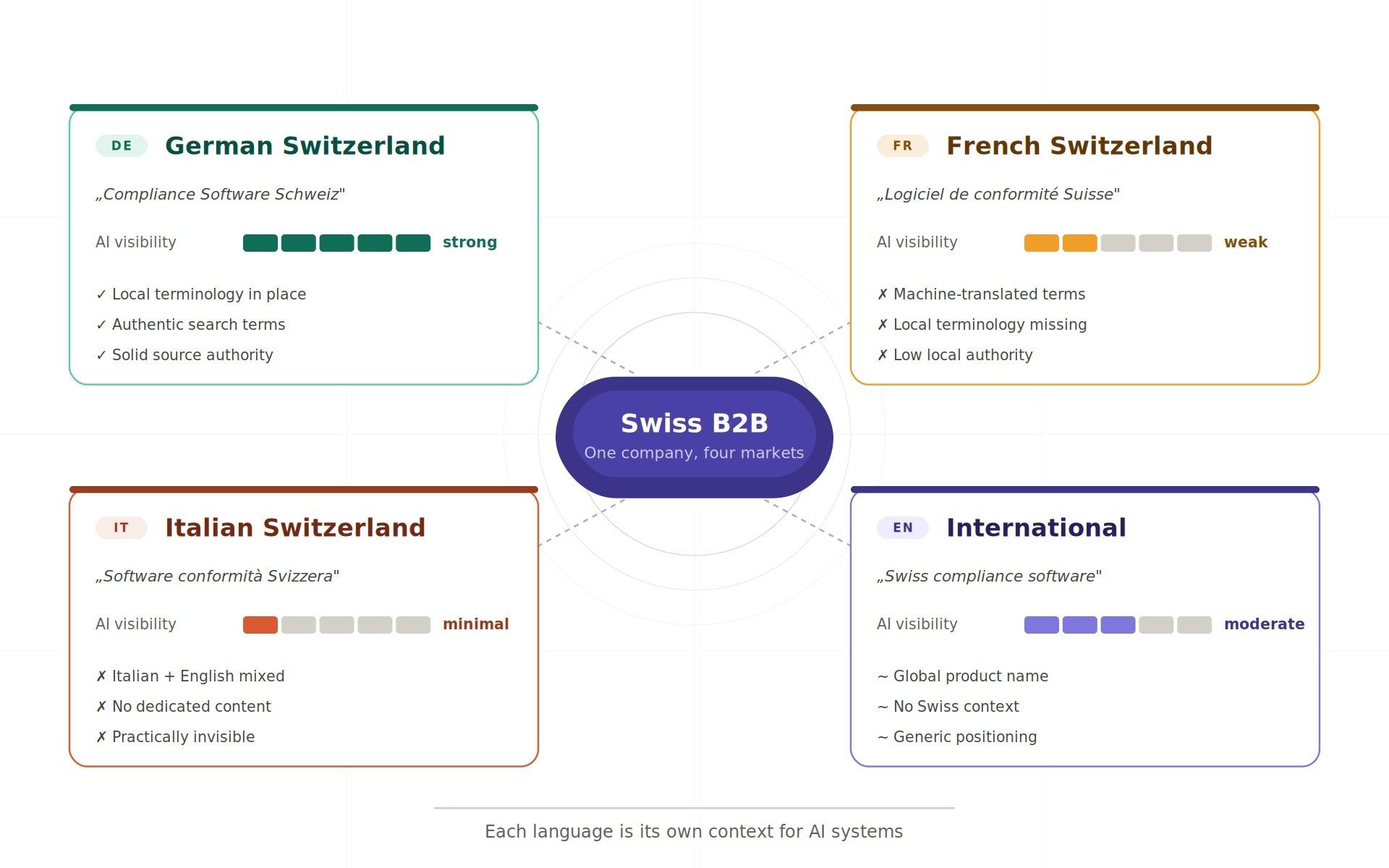
Consider a Swiss SaaS company offering a compliance solution. Its German page may rank reasonably well for "Compliance Software Schweiz." Its French page, machine-translated from the German, might use terms that no French-speaking compliance officer in Geneva actually types. The English page may use a global product name that has no resonance in DACH. Each market sees a slightly different version of the company, and none of them is fully optimized.
For Swiss marketing managers, this means the AI search opportunity is also a chance to clean up something that has been broken for years. Building local-language content that reflects how buyers in each region actually research and decide is no longer a nice-to-have. It is becoming the difference between being part of the conversation and being invisible in it.
This is also where lean Swiss teams can use AI tools to their advantage. The same generative systems that are reshaping discovery can support the production of higher-quality multilingual content, provided the strategy and oversight come from people who understand the local market.
4. Where AI Actually Creates Value for Swiss SMEs and Scale-Ups
A common reaction in Swiss B2B is to assume that AI is a topic for large enterprises with dedicated AI teams. That is not how the picture looks in practice. Lean marketing teams often have the most to gain, precisely because they have the least capacity to begin with.
The value tends to appear in a few concrete areas.
Research and synthesis is one of the clearest. Understanding competitors, mapping buyer personas, summarizing industry reports, and preparing for sales conversations can all be accelerated significantly. Tasks that used to consume half a day can be drafted in twenty minutes, leaving more time for interpretation and decision-making.
Content production is another. Not as a way to flood the internet with generic articles, but as a way to produce more thoughtful, locally relevant content across multiple languages without doubling team size. The goal is not more content. It is the right content, faster.
Campaign analysis and reporting benefit in a similar way. Pulling together performance across LinkedIn, Google, programmatic, and email into a clear narrative for management used to require hours of manual work. With AI-supported workflows, the same exercise becomes faster and more consistent, which is particularly useful for small teams that need to report up while also executing.
AI search audits help teams understand where they currently appear in AI-generated answers, where they do not, and why. For most Swiss B2B companies, this is uncharted territory. A first audit often reveals significant gaps that are relatively straightforward to address once they are visible.
These are not exotic use cases. They are the kind of practical improvements that fit a Swiss SME marketing team's daily reality.
5. The Trap of Doing Too Much, Too Fast
There is a temptation, when a topic like AI search becomes prominent, to launch a large initiative. New tools, new agencies, new internal projects, new dashboards.
For most Swiss SMEs and scale-ups, that approach creates more friction than progress. Lean teams cannot absorb large transformations on top of their existing workload. Budgets are real. Attention is scarce.
A more useful approach is to start with two questions. Where are buyers actually researching today, and what do they find when they look for us? Honest answers to those two questions tend to point directly to the highest-value first steps.
In many cases, the priority is not new technology but better fundamentals. Clearer positioning. Structured product and solution pages. Consistent terminology across languages. A handful of well-written pieces that genuinely answer the questions buyers are asking. These are the assets that both humans and AI systems can work with.
Once those fundamentals are in place, more advanced layers become possible. AI search optimization. Custom workflows. Internal AI agents for specific recurring tasks. Conversational experiences on the website. Each of these has a place, but they work best when they sit on top of a clear foundation rather than compensating for the absence of one.
6. What Changes for Marketing Managers Specifically
If you are running marketing at a Swiss SME or scale-up, your role is changing in ways that are easy to underestimate.
The expectations from leadership are shifting. Faster turnarounds. More data-informed recommendations. More languages covered with the same team size. Clearer attribution. More inbound pipeline from less obvious channels. These are not new pressures, but AI is accelerating them.
At the same time, the nature of the work itself is shifting. Less time on first drafts and routine reporting. More time on interpretation, prioritization, and decisions about where to invest. The marketing manager who simply produces more content will not be more valuable. The marketing manager who can use AI to surface sharper insights and build better workflows will be.
This is also why the skill profile of effective Swiss B2B marketing is broadening. Strategic thinking, operational discipline, language sensitivity, and a working understanding of AI systems are no longer separate competencies. They are part of the same job.
For many marketing managers, this is genuinely good news. The most repetitive parts of the role are exactly the parts AI is best at supporting. The parts that require judgment, context, and relationships are exactly the parts that remain human.
7. The Realistic Twelve-Month Picture
It is worth being clear about what is and is not going to happen in the next year.
AI search will not replace traditional search overnight. Google will remain a major driver of B2B traffic in Switzerland for some time. Established channels like LinkedIn, email, events, and partnerships will continue to matter, especially in relationship-driven Swiss B2B sectors.
What will change is the share of buyer journeys that pass through AI-mediated discovery, and the share of decisions that are influenced before a buyer ever visits your website. That share is growing steadily. Companies that adapt early will compound an advantage over those that wait.
For Swiss B2B marketing teams, the realistic twelve-month goal is not transformation. It is positioning. A clear understanding of where you appear in AI answers and where you do not. A multilingual content foundation that works for both human and machine readers. A small number of AI-supported workflows that genuinely save time. A reporting setup that makes the impact visible to leadership.
That is enough to be ahead of most of the Swiss market. It is also achievable within the constraints of a normal marketing budget and a small team.
Conclusion
The shift toward AI search and AI-supported marketing is not a dramatic event. It is a series of small changes that, taken together, are redefining how Swiss B2B buyers discover, evaluate, and choose vendors.
The companies that will benefit most are not necessarily the ones with the largest AI budgets or the loudest announcements. They are the ones that understand their own market, their own languages, and their own buyers well enough to apply AI where it actually creates value.
For Swiss SMEs and scale-ups, this is a moment of real opportunity. The playing field is being reshuffled. Lean teams that move thoughtfully now can establish a position that larger, slower competitors will struggle to match later.
The question is not whether AI will change Swiss B2B marketing. It already is. The question is whether your team will shape that change or simply react to it.
Curious where your company currently shows up in AI search across German, French, and English? Contact us for an AI search audit tailored to the Swiss B2B reality.
Frequently Asked Questions (FAQ)
Is AI search really relevant for Swiss B2B already?
Yes. A growing share of B2B buyers in Switzerland uses ChatGPT, Perplexity, Claude, or Gemini as part of their research, often before any traditional search. Even when buyers still rely on Google, AI Overviews and AI-generated summaries are influencing what they see and click. The impact is no longer hypothetical, particularly in technology, professional services, and SaaS.
How is AI search different from traditional SEO?
Traditional SEO optimizes for ranking on a results page. AI search optimization focuses on being included, named, and accurately represented in the synthesized answers generated by AI systems. The technical foundations overlap, but the priorities shift toward structured content, clear positioning, consistent terminology, and answer-shaped writing rather than keyword density.
What should a Swiss B2B marketing team do first?
The most useful first step is an honest audit. Where does the company appear in AI-generated answers across its core languages, and where does it not? That assessment usually reveals quick wins in positioning, content structure, and multilingual consistency before any larger investment is needed.
Do small teams really benefit from AI, or is this only for large companies?
Small teams often benefit the most. Lean marketing teams have limited capacity, and AI is particularly effective at reducing the time spent on research, first drafts, reporting, and multilingual content adaptation. The result is not necessarily more output, but more time for the strategic decisions that actually move the business.
How does the multilingual aspect change the AI search approach in Switzerland?
Significantly. AI systems treat each language as a separate context. A strong German page does not automatically translate into French or Italian visibility. Swiss companies that build genuinely local content in each language, rather than relying on machine translation, will be far better positioned in AI-generated answers across the country and the wider DACH region.
🇨🇭TRENDBOOK 2026: The 5 Marketing Trends
Marketing is entering a new era.
The media landscape is changing faster than ever. Yesterday's strategies are no longer enough.
This Trendbook gives you the keys to transform this mutation into an opportunity.