
The Ad Context Protocol (AdCP) marks a turning point in digital advertising. With the first productive tests rolling out in 2025, this protocol is set to transform the entire campaign lifecycle – from strategic planning to automated delivery. Leveraging Artificial Intelligence (AI) and autonomous agent systems, AdCP finally fulfills the long-standing promise of true process optimization in programmatic advertising.
What is the Ad Context Protocol (AdCP)?
Definition and Origins of the Protocol
The AdCP is an open protocol developed by a consortium of leading industry players, including Yahoo, PubMatic, Optable, Scope3, Swivel, and Triton Digital. Its ambitious goal: to unify advertising workflows across all platforms. A standardized interface allows AI agents to support and automate pricing and placement negotiations within defined parameters.
Unlike traditional advertising, where humans manually set rules and campaign parameters, AdCP takes a decisive step forward: AI agents can independently process briefs, conduct negotiations, and execute purchases using natural language. This represents a paradigm shift in the relationship between humans and machines within the advertising ecosystem.
A New Paradigm: From Automation to “Agentic Advertising”
While traditional programmatic advertising merely automates repetitive tasks, AdCP introduces the concept of “agentic advertising”. Here, AI agents act as autonomous actors capable of:
- Interpreting strategic briefs: Understanding the intent behind a campaign.
- Adjusting purchases in real time: Responding instantly to market changes.
- Negotiating optimal terms: Conducting pricing and placement discussions independently.
- Continuously optimizing campaigns: Improving performance without constant manual intervention.
How Does the Ad Context Protocol Work?
The Three Pillars of AdCP
The protocol is structured around three core modules:
1. Signals Activation Protocol
This module identifies and activates contextual audiences. It enables more efficient use of contextual signals (such as content, user environment, and context) without relying solely on first-party data. This capability is especially critical in the post–third-party cookie era.
2. Media Buy Protocol
This module manages the entire campaign lifecycle, from initial planning to real-time optimization. AI agents handle key tasks, including:
- Analyzing available inventory
- Negotiating prices
- Placing bookings
- Adjusting strategies based on performance
3. Creative Protocol
This module standardizes the management and optimization of ad creatives. It empowers AI agents to:
- Select the most relevant visuals
- Automatically adapt formats to specific inventory
- Independently optimize creative performance
Technical Architecture and System Compatibility
AdCP is built on a modular and flexible architecture, enabling gradual integration into existing ecosystems. Communication between AI agents relies on open standards, ensuring seamless compatibility across different platforms.
AdCP vs. OpenRTB: Complementary, Not Competitive
Clearing Up Misconceptions
A key question arises: does AdCP replace the long-standing OpenRTB standard for real-time auctions?
The good news: no. AdCP and OpenRTB are complementary, enhancing each other’s capabilities. Platforms can leverage both protocols simultaneously to maximize overall efficiency.
Different Roles, Shared Goals
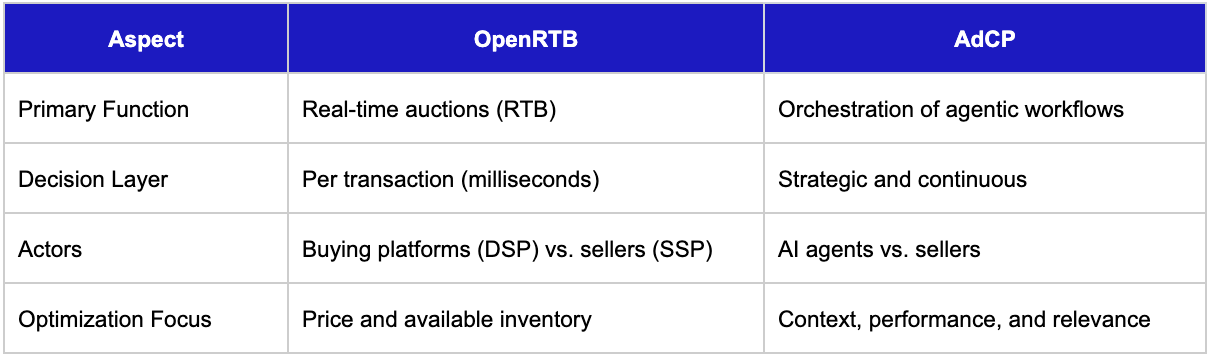
In summary, OpenRTB handles the bidding process, while AdCP orchestrates the direct and optimized execution of purchases, driving broader business objectives.
Transparency and Auditability: The Foundation of Trust
A Clear Commitment to Traceability
The developers of AdCP emphasize that the protocol increases transparency in digital advertising on multiple levels:
- ✅ Fewer intermediaries, greater clarity: Direct transactions between buying and selling agents reduce unnecessary complexity and opacity.
- ✅ Open source: The protocol’s open code allows the entire industry to independently verify technical implementations.
- ✅ Immutable audit trails: Every single transaction is fully and consistently recorded, providing a solid foundation for auditable, tamper-proof records.
- ✅ Data traceability: Full visibility into how data flows through the system.
- ✅ Privacy protection: All implementations are required to integrate current privacy standards by design.
Towards More Responsible Advertising
With the gradual end of third-party cookies and increasingly strict regulations (such as GDPR and CCPA), AdCP positions itself as the ideal standard for the future of digital advertising through its strong focus on transparency.
Strategic Value for Advertising Teams
Immediate Opportunities
AdCP offers significant strategic advantages for operational work:
🚀 Accelerated Operations
- Shorter lead times from campaign planning to launch.
- Automation of administrative tasks and technical campaign setup.
- Faster time-to-market for new creatives.
🎯 Consolidation of Skills
- Greater focus on strategy instead of navigating multiple interfaces.
- Reduced ramp-up time for new tools.
- Teams can dedicate capacity to higher-value, strategic tasks.
📊 Enhanced Traceability and Control
- Immutable log files for complete, audit-ready records.
- Detailed, granular insights into performance data.
- Easier compliance with regulatory requirements.
🤝 Collaborative Innovation
- Opportunity to actively shape the open-source protocol.
- Influence the development of future industry standards.
- Position your company as a leader in innovation.
Impact on the Organization
- New Roles: Emergence of specialized positions such as “AI Agent Supervisors” or experts in “Algorithmic Governance.”
- Reduced Friction: Streamlined coordination between different systems.
- Increased Agility: Faster responsiveness to dynamic market changes.
Anticipating and Overcoming Challenges
Like any new industry standard, AdCP comes with challenges that need to be addressed:
- Market Adoption: Leading DSPs, SSPs, and publishers must actively integrate the protocol to achieve critical mass.
- Neutral Governance: The standard’s development must remain impartial and not dominated by any single market player.
- Seamless Transition: Integration with the established OpenRTB standard must ensure uninterrupted operations and consistent performance.
- New Skill Profiles: Professionals in AI and algorithmic governance are needed to competently manage and oversee autonomous agents.
Despite these hurdles, the gradual adoption of AdCP is essential for remaining competitive in the digital advertising landscape of tomorrow.
Conclusion: Adapt or Fall Behind
The Ad Context Protocol won’t transform the industry overnight. However, it represents the natural evolution of programmatic advertising toward greater automation, transparency, and intelligence.
Teams that adopt this standard early will secure a sustained competitive advantage, whether through increased operational efficiency, enhanced innovation, or reliable regulatory compliance.
The question today is no longer, “Should we embrace AdCP?” but rather, “When and how will we get started?”
Do you have questions about the Ad Context Protocol or want to learn how to integrate it successfully into your advertising strategy? Our expert team is here to guide you.
FAQ: Key Questions About AdCP
Q1: How does AdCP ensure data privacy and compliance with GDPR/CCPA?
Answer: AdCP was designed from the ground up according to Privacy-by-Design principles. The protocol requires that every implementation includes:
- Consent Management: User consent is strictly verified before any audience activation takes place.
- Data Minimization: Only the data strictly necessary for a given campaign is transmitted.
- Compliance Audibility: Complete logs allow full verification of regulatory compliance to authorities.
Right to Be Forgotten: Mechanisms to handle deletion requests are integrated directly into the system.
Unlike closed, proprietary systems, AdCP’s open-source approach enables independent external verification of data privacy compliance.
Q2: Will AdCP completely replace media traders?
Answer: No—but their roles will fundamentally evolve. The likely scenario:
Tasks that will disappear:
- Basic technical campaign setup
- Repetitive, manual optimization steps
- Purely administrative reporting
New roles that will emerge:
- AI Advertising Strategists: Define overarching goals and frameworks for AI agents.
- Agent Supervisors: Monitor and guide the decisions of autonomous systems.
- Context Specialists: Identify the most relevant contextual signals for brand targeting.
- Strategic Client Advisors: Provide clients with high-level, business-oriented guidance.
Historical Analogy: Just as Excel didn’t make financial analysts obsolete but transformed the way they work, AdCP will shift media traders toward a more advisory and strategic role, empowering them to focus on higher-value tasks.
🇨🇭TRENDBOOK 2026: The 5 Marketing Trends

Marketing is entering a new era.
The media landscape is changing faster than ever. Yesterday's strategies are no longer enough.
This Trendbook gives you the keys to transform this mutation into an opportunity.