Without third-party cookies, the only thing that still matters in marketing is a direct, honest relationship. Switzerland’s Data Protection Act (nFADP) is not an obstacle here, but a major competitive advantage for consent-based marketing. Those who build their own data ecosystem today secure their independence from the major tech platforms.
The era of anonymous user tracking is drawing to a close. At the same time, this creates a unique opportunity for Swiss companies: while Google and Meta are revising their tracking models, you can build trust through transparent, consent-based marketing, the most valuable asset in digital marketing.

The Reasons Why First-Party Data Is the New Gold Standard
1. Legal Certainty Through nFADP Compliance
The new Swiss Data Protection Act (nFADP) creates clear rules of the game:
- Explicit consent instead of hidden tracking codes
- Transparency about data use becomes the norm
- Data minimization as a business principle
Companies that invest in first-party data strategies now are automatically future-proof and gain a compliance advantage over competitors that still rely on outdated methods.
2. Higher Data Quality and Reliability
First-party data includes data collected directly from the user and therefore neither relies on inferences nor is distorted by tracking gaps. It consists of up-to-date data that reflects genuine user preferences instead of merely reproducing derived assumptions. In addition, it is especially rich in context, as it shows not only what the user does, but also why they do it. While third-party cookies are becoming increasingly inaccurate, the quality of your first-party data continues to improve.
3. Independence from Platform Changes
Apple’s iOS tracking limits, Google’s Privacy Sandbox, and regulatory restrictions on Meta do not represent direct risks in this case. With your own data ecosystem, you remain independent of such external shocks.
First-Party Data in the Marketing Mix: Practical Applications
A) Organic Channels (SEO, Content, Email)
Email Marketing Reimagined:
Segmentation through first-party data: user behavior on the website, product interests, purchase history instead of vague demographics
Personalized content recommendations: every email recipient receives content based on their genuine interests
Predictive engagement scoring: which users are ready to buy? First-party data reveals it
For example, an online shop collects first-party data through consent banners and product reviews. The email software automatically segments this data into users with a need for accessories based on their purchase history, customers who have written a review and are therefore considered highly engaged, as well as prospects who have viewed a product multiple times and are therefore classified as ready to convert.
Content-Strategie with First-Party Insights
- Document user questions (via search, chatbots, support)
- Create blog content specifically tailored to actual needs
- Optimize internal linking strategies based on user journey data
SEO Advantage: Engagement Signals
- Longer dwell time through more relevant content
- Higher click-through rates in search results (when your content titles address real user needs)
- Better Core Web Vitals through data-driven UX optimizations
B) Paid Channels (Paid Ads, Remarketing, Conversion Optimization)
1. Audience Building Without Third-Party Cookies
With Lookalike Audiences 2.0, Google no longer tracks website visitors. Instead, the best customers are uploaded directly to Google or Meta based on first-party data. The platforms then identify similar users, while control over the underlying data is maintained.
In consent-segmented retargeting, website visitors are segmented according to their actual behavior, such as whether they viewed product pages or abandoned their shopping cart. Precisely relevant ads are then delivered, leading to a higher CTR and better ROAS.
2. Conversion-Tracking with First-Party Data
The problem with third-party cookies is that Google and Meta are becoming less and less able to detect how users convert, for example due to iOS limits and browser restrictions. The first-party solution is to track conversions on your own website yourself, for example through server-side tracking, and then share this conversion data with the platforms via APIs such as the Google Conversions API or the Meta Conversions API. This allows the platforms’ AI models to be trained on real conversion data rather than mere assumptions. The result is better bid optimization, because Google and Meta know which types of users actually convert.
3. First-Party-Based Programmatic Advertising
With slow-moving products, it is possible to identify which customer types buy them, allowing smart bidding to be adjusted in a targeted way.
With cross-selling potential, first-party data reveals complementary purchasing patterns, making it possible to serve dynamic ads with relevant products.
In the case of churn risk, first-party data identifies the best customers before they drop off, enabling targeted re-engagement campaigns.
C) Integrated Strategies (Paid + Organic Synergies)
Data-Driven Keyword Strategy
- Collection: first-party data shows which search terms users use (via Analytics, Search Console)
- Content: create organic content for these keywords
- Paid amplification: promote these best-performing pieces of content in Google Ads
- Feedback loop: conversion data from paid campaigns informs the next content iteration
Attribution & Budget-Allocation
First-party data enables true cross-channel attribution. This makes it visible how organic search works across the website visit, the email, and paid retargeting all the way through to conversion. Budget decisions are therefore based on real ROI rather than distortion caused by the last-click model.
Practical Steps for Building First-Party Data
Phase 1: Infrastructure (Week 1–4)
- Implement a consent management system (OneTrust, Termly, Osano)
- Switch analytics tracking to a first-party basis (GA4 with your own property)
- Cookie-free tracking for important events (form submissions, product views)
Phase 2: Data Collection (Week 5–12)
- Launch opt-in campaigns (newsletters, login incentives, content upgrades)
- Create customer profiles (link the CRM system with website data)
- Collect high-quality data (not just clicks, but preferences and intent)
Phase 3: Activation (Week 13+)
- Implement email segmentation
- Activate the Conversion API for Google Ads and Meta Ads
- Test dynamic ads with first-party data segments
- Revise attribution models
Common Misunderstandings
Myth 1:
"First-Party Data = Data protection does not matter"
Correct Version: First-party data with GDPR/nFADP compliance is the goal. Not just tracking without prohibition.
Myth 2:
"We can use first-party data immediately in the same way as third-party cookies."
Correct Version: You need active user consent. In return, the quality is significantly higher.
Myth 3:
"This is too complicated for small businesses."
Correct Version: The basics (consent banner, newsletter, CRM) are already standard. The technical complexity is continuously decreasing.
Conclusion: Trust as a Competitive Advantage
The era of anonymous mass surveillance is coming to an end, not only from a regulatory perspective, but also a technological one. Companies that now invest in direct, trust-based customer relationships will win:
- Legal certainty (nFADP compliance from day one)
- Better data durability (not dependent on platforms)
- Higher ROAS (more relevant ads through real data)
- Customer loyalty (transparent, respectful marketing)
- Long-term competitiveness (independent of upcoming tech changes)
The message is clear: in tomorrow’s data ecosystem, trust is not the obstacle, but the solution.
Would you like to make your first-party data strategy more concrete? Let’s analyze it together:
- Where you are still too dependent on third-party data today
- Which quick wins you can implement immediately
- How you can even improve your marketing performance in the process
🇨🇭TRENDBOOK 2026: The 5 Marketing Trends
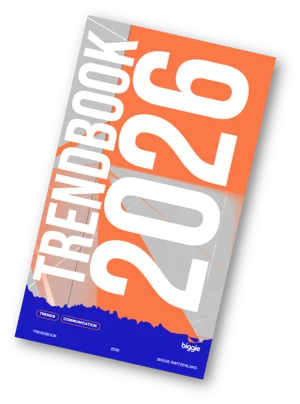
Marketing is entering a new era.
The media landscape is changing faster than ever. Yesterday's strategies are no longer enough.
This Trendbook gives you the keys to transform this mutation into an opportunity.