



Discover the real impact of tone on AI responses and the best practices for optimizing your prompts.
Should you say "thank you" to an AI?
Saying “please” or “thank you” to artificial intelligence has become a reflex for many users. As conversational models increasingly mirror human social cues, our interactions naturally follow suit.
But beyond this instinct, one question comes up more and more often:
“Does tone actually influence AI?”
Politeness and AI Performance: What Does the Research Say?
A study conducted by Waseda University and the Riken Institute found that moderately polite prompts produce, on average, more relevant, better-structured, and reliable responses. Tone acts as an implicit quality signal here: clear, respectful, and measured language steers the model toward more rigorous outputs.
However, the more recent study, Mind Your Tone: Investigating How Prompt Politeness Affects LLM Accuracy, offers an interesting counterpoint.
Politeness levels yield counter-intuitive results
By testing 250 prompts (50 questions adapted into 5 tone levels, ranging from highly polite to highly rude) on models like GPT-4o, researchers observed a counter-intuitive trend:
- Highly polite: 80.8% accuracy
- Polite: 81.4%
- Neutral: 82.2%
- Rude: 82.8%
- Highly rude: 84.8%
In other words, within this specific framework, the most direct, and even aggressive, prompts actually yield the best results.
This discrepancy suggests that there is no clear-cut rule linking politeness to performance. Tone does have an impact, but its effects depend heavily on the model, the type of task, and the overall phrasing. One thing is certain: excessive politeness appears counter-productive across both tests.
The core issue: AI doesn't understand politeness, it interprets it
Unlike humans, AI doesn't "feel" anything. It perceives neither respect nor aggression.
However, it has been trained on billions of human texts where tone serves as a strong contextual indicator. A polite prompt can therefore trigger the AI to deliver more educational and structured answers, while a direct approach tends to produce more concise, execution-oriented responses.
Some research goes even further: the level of politeness actually acts as a role signal.
Role interpretation based on tone
Depending on how you address it, the AI "interprets" the scenario as an interaction between:
- a superior giving an order
- a peer collaborating on a task
- a user asking for help
And this tangibly influences the output it generates.
A matter of form... with a very real cost
Beyond performance, politeness has a highly concrete impact: it drains resources.
Every query sent to an AI requires massive computing power, up to 10 times more than a standard web search, according to estimates from the International Energy Agency.
And every single word counts.
OpenAI CEO Sam Altman noted that simple pleasantries ("hello," "thank you," "please") account for tens of millions of dollars in electricity and infrastructure costs.
At a massive scale, these few seemingly harmless words transform into a significant economic and environmental issue.
Why do we still default to politeness?
If politeness is neither consistently optimal nor free, why does it persist?
Because it triggers a deeply human reflex: anthropomorphism. We naturally project relational codes designed for humans onto machines.
This is nothing new. We say "thank you" to our GPS, we apologize to voice assistants. We spontaneously adopt social cues in environments that simply don't require them.
But with generative AI, this instinct is even stronger, because these models mimic human language well enough to blur the lines.
For researchers like Sherry Turkle, how we speak to AI is ultimately a reflection of our own social norms. Adopting an aggressive or bossy tone, even with a machine, can actually bleed into our daily communication habits with others. Conversely, maintaining a baseline of courtesy is a matter of behavioral consistency.
In other words: we don't say "thank you" for the AI's sake, but for our own.
In conclusion
Politeness does impact an AI's responses... but it isn't the primary driver.
The key takeaway is that tone alone doesn't dictate performance.
What truly makes the difference is how your prompt is structured.
The anatomy of an effective prompt
AI performs best when your prompt is:
- clear (the objective is immediately obvious)
- precise (there is no ambiguity about what is expected)
- structured (instructions, context, and desired format are well-defined)
- contextualized (the background and purpose of the request are provided)
In this context, politeness is neither mandatory nor useless. While it can help establish a more natural flow, it can never compensate for a lack of clarity.
Ultimately, this research highlights a new paradigm of interaction.
We no longer speak to AI the way we do a search engine, nor do we speak to it exactly like a human.
The goal is to strike a balance: use simple, natural language that remains highly results-oriented.
In this new landscape, knowing exactly how to phrase a request has become a vital skill.
How Biggie can help
AI plays a central role at Biggie, which is why we have developed several proprietary solutions in-house to integrate these technologies into our workflows in a practical and controlled manner.
Our approach is simple: extract the maximum value from AI without compromising on high standards or quality.
This relies just as much on the tools themselves as on how they are used: from crafting prompts and structuring requests to analyzing outputs.
If you are navigating these topics or looking to seamlessly integrate AI into your business practices, we can guide you.
Let's talk. Contact us today!
FAQ – The most common questions about AI and politeness
Should you say thank you to an AI?
No, it’s not necessary. Saying "please" or "thank you" does not directly improve output quality. What matters most is the clarity, precision, and structure of your prompt.
Does politeness improve AI responses?
Not systematically. Some studies show that neutral or highly direct phrasing can actually yield more accurate results. While tone influences the style of the response, it remains secondary to the overall quality of the prompt.
How do you write a good AI prompt?
A good prompt must be clear, precise, and structured. To get highly relevant results, it should always include a clear objective, relevant context, and ideally, the expected output format.
🇨🇭TRENDBOOK 2026: The 5 Marketing Trends
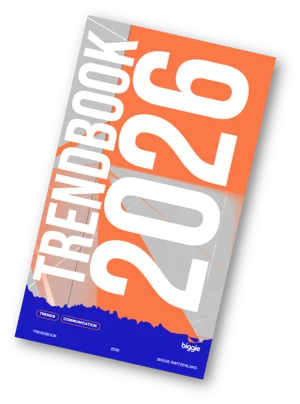
Marketing is entering a new era.
The media landscape is changing faster than ever. Yesterday's strategies are no longer enough.
This Trendbook gives you the keys to transform this mutation into an opportunity.


