Imagine asking ChatGPT to help furnish a small apartment in Zurich. You have a budget, a difficult staircase and a moving date in three weeks. By the time you have explained all that, a useful furniture ad has quite a specific job to do. It needs to show you something that fits and help you work out whether you can actually get it into your home.
That is the opportunity we find interesting about ChatGPT Ads. A conversation can reveal the practical details behind a decision. Those details give brands a much better brief.
At Biggie Switzerland, early access enabled us to launch ChatGPT Ads around a week ahead of the wider rollout. Being able to start early gave us a head start in working with the channel. It also shaped the questions we bring to clients: which decisions can your brand help with, what should happen after someone encounters the ad, and how will we know whether it helped?
The platform has added a lot since then. Conversion optimisation, more flexible attribution and new integrations make it easier to build and measure campaigns. AI agents point towards a further change: the conversation itself could become a place where a customer gets things done.
A useful ad starts with an unfinished decision
It is tempting to take a successful search campaign, move the copy into ChatGPT and expect familiar results. We think the better starting point is to look at what remains unresolved for the customer.
Take the apartment example. “Affordable sofas” addresses price. “A sofa that fits through a narrow staircase” addresses the obstacle that could prevent the purchase. The same product might answer both needs, but the message, proof and landing page should reflect the particular concern.
This is how we connect prompt research with media planning. We group related questions into decision contexts, then build ad groups around them. One context might concern dimensions and delivery; another might concern durability in a household with children. Each deserves a distinct reason to choose the product.
Context hints help describe those situations to OpenAI. They guide matching without guaranteeing placement against an exact prompt. The discipline on our side is to make the offer, message and destination agree. If the ad promises help with dimensions, the customer should find dimensions immediately.
A good place to look for creative ideas is therefore the questions customers ask before buying. Sales teams, customer service and on-site searches can be as useful here as a keyword report.
Switzerland makes the details matter
For a Swiss advertiser, the customer’s next question is often very local. Does this price include delivery? Is the product available here? Can I speak to someone in French? Will this offer apply in Ticino?
Translating a headline covers only part of that work. A French ad leading to a German product page, or an attractive offer with unclear Swiss delivery terms, leaves the customer to finish the job. We would fix that before spending more to bring people in.
The same logic applies to testing. A focused campaign in one language market, with an appropriate offer and a clear destination, gives a team something it can interpret. Spreading a modest budget across several languages, products and objectives can leave too little evidence to explain any result.
And the size of ChatGPT’s overall audience should stay separate from the reachable advertising audience. Ads may appear for eligible Free and Go users; several paid plans remain ad-free. That distinction belongs in the media plan, however impressive the headline user numbers look.
A better-looking dashboard still needs explaining
Conversion campaigns can now use click billing or impression billing, subject to eligibility. With impression billing, eligible conversions following views as well as clicks can inform optimisation. That creates more room to evaluate journeys where a person sees an offer and acts later.
It also makes interpretation more important. Changing the attribution window changes the conversions credited in reporting. It does not, by itself, improve the underlying campaign. We want the team looking at the same window over time and understanding how much of the total followed a click or a view.
For lead generation, our preferred conversation goes one step further: did those enquiries turn into qualified prospects? An inexpensive form submission and a valuable new customer can sit a long way apart. Connecting campaign reporting with CRM outcomes helps reveal that distance.
The GA4 integration, currently in beta with early access through account managers, can support attribution comparisons and optimisation where eligible. HubSpot brings campaigns closer to lead capture and follow-up workflows. These are useful connections, provided the events mean the same thing to the media team and the business.
OpenAI’s early work on incrementality and brand measurement is encouraging for the same reason. Attribution tells us which outcomes received credit. A well-designed experiment can help answer whether advertising generated additional business. Swiss advertisers will need evidence relevant to their own campaigns before using another market’s results to set expectations.
Creative automation puts your source material to work
Creative enhancements can adapt headlines and descriptions, translate text, resize images and adjust destination URLs. OpenAI says automatic enablement is scheduled from 31 October, while preserving existing opt-outs. Enabled variations can run without a team approving every version.
For us, the implication is very practical: the website becomes part of the creative brief. Outdated promotions, vague benefits and inconsistent product information give automation poor material to work with. Clear claims, current availability and useful product details give it a firmer foundation.
There is still a creative decision to make. A sofa can be presented as compact, comfortable, durable or easy to deliver. Choosing which promise matters in a particular situation requires an understanding of the customer. Generating variations makes it easier to test that judgment.
The visual format announced in October, initially for US testing during image generation, adds another way to tell that story. We see an opportunity for brands whose value benefits from being shown in use. Swiss availability needs confirmation before it enters a campaign plan.
AI agents could carry the conversation further
Now return to the person furnishing the Lausanne apartment. After seeing the sofa, they still need to check the measurements, ask about delivery and perhaps compare fabrics. Today, those tasks might take them through several pages and a call to customer service.
A useful brand agent could help them resolve those questions in one conversation. In a more connected future, it might check stock, prepare a quote or help arrange an appointment—with the customer choosing whether to proceed. Those are possibilities we would design towards, rather than capabilities we assume every advertising account already has.
OpenAI’s Sponsored Agents provide an early indication of that direction: people can open a conversation with a business’s AI representative from an ad. The format remains a limited alpha for selected advertisers. OpenAI is not currently accepting early-access requests.
Our view is that this could change how a media campaign is briefed. Alongside the promise in the ad, a brand would need to define what its agent can help the customer accomplish. A recruitment campaign might help someone understand a role and book an information session. A retailer might help someone find a product that meets a specific constraint.
That would also change what we measure. The number of conversations started would tell us about engagement. We would still want to know whether people found suitable products, completed bookings or reached a person who could help them. A long conversation can signal interest; it can also signal confusion.
The preparation reaches beyond the media team
There is a second agent scenario worth thinking about: customers may increasingly ask their own assistants to research options for them. If that happens, brands will need product information that is accessible, consistent and easy to verify. Details such as compatibility, service coverage and delivery conditions could influence whether an offer survives the comparison.
We expect this to bring brand, content, technology and customer service teams closer together. An agent representing a business needs reliable information, defined permissions and a sensible route to human help. If it can make appointments or check an order, the systems behind those actions have to work. Good media buying can bring a customer to that experience; the business has to fulfil the promise.
This is also why we discuss GEO and paid activation together. Understanding how a brand appears in AI answers helps identify gaps in information and customer understanding. Those findings can inform paid tests and, eventually, the questions a brand agent should be equipped to answer.
The two still need separate measurement. Paying for an ad does not change ChatGPT’s independent answer or buy an organic recommendation. Their connection is strategic: a shared understanding of the customer and a consistent account of what the brand offers.
Where we would start
For a Swiss brand considering ChatGPT Ads, we would begin with one worthwhile customer decision. Choose an offer that deserves attention, make the relevant language and landing page work properly, and agree what success means beyond the first click. Then test, learn and decide where the evidence supports more investment.
For agents, we would start with a question the business already handles well. Build around an answer customers can trust, then consider a useful next action. The pace of the platform’s development will vary. The value of helping someone make a good decision is already clear.
At Biggie Switzerland, that is where we see the opportunity: bringing media, creative and AI expertise together around the next useful step for the customer.
Talk to Biggie Switzerland about a ChatGPT Ads pilot and how conversational experiences could fit your brand’s customer journey.
FAQ – Frequently asked questions
1. Which ChatGPT users actually see ads?
Ads appear only to eligible Free and Go plan users. Several paid subscription tiers remain completely ad-free, meaning total platform traffic does not equal reachable advertising audience.
2. How do ChatGPT Ads differ from traditional search ad campaigns?
Instead of relying solely on keywords, ChatGPT Ads target specific customer "decision contexts" and practical obstacles. Advertisers use context hints to match the user's conversational situation directly with a tailored message and landing page.
3. What specific challenges do Swiss advertisers face on the platform?
Advertisers must manage language localization carefully ensuring ad language matches destination pages (e.g., French ads leading to French pages) and clearly communicate local specifics such as Swiss delivery terms, pricing, and regional availability.
4. How is performance tracked and attributed?
Performance can be measured via a tracking pixel and also server side tracking is supported, beta integrations with Google Analytics 4 (GA4), and connections to CRMs like HubSpot to verify whether incoming enquiries turn into qualified leads.
5. What are Sponsored Agents, and are they currently available to all advertisers?
Sponsored Agents allow users to converse directly with a business’s AI representative straight from an ad to complete tasks or answer questions. Instead of landing on the website users can interact with an AI agent. They are currently in a limited alpha test for selected advertisers and are not open for public early access.
🇨🇭TRENDBOOK 2026: The 5 Marketing Trends
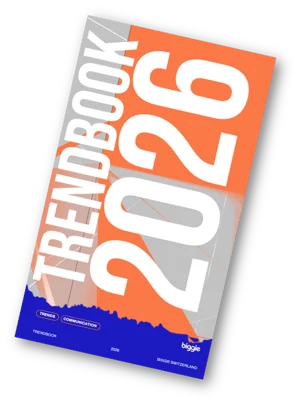
Marketing is entering a new era.
The media landscape is changing faster than ever. Yesterday's strategies are no longer enough.
This Trendbook gives you the keys to transform this mutation into an opportunity.