


ChatGPT has become a daily companion for millions of people: a place to think, write, plan, and solve problems. That makes one question increasingly relevant:
Will there be ads in ChatGPT?
The short answer: yes - in limited testing.
The longer answer: advertising is being explored carefully, with strict principles designed to protect trust, privacy, and the usefulness of the product.
Here’s what we know so far.
Are there ads in ChatGPT right now?
Yes - but only in a controlled test.
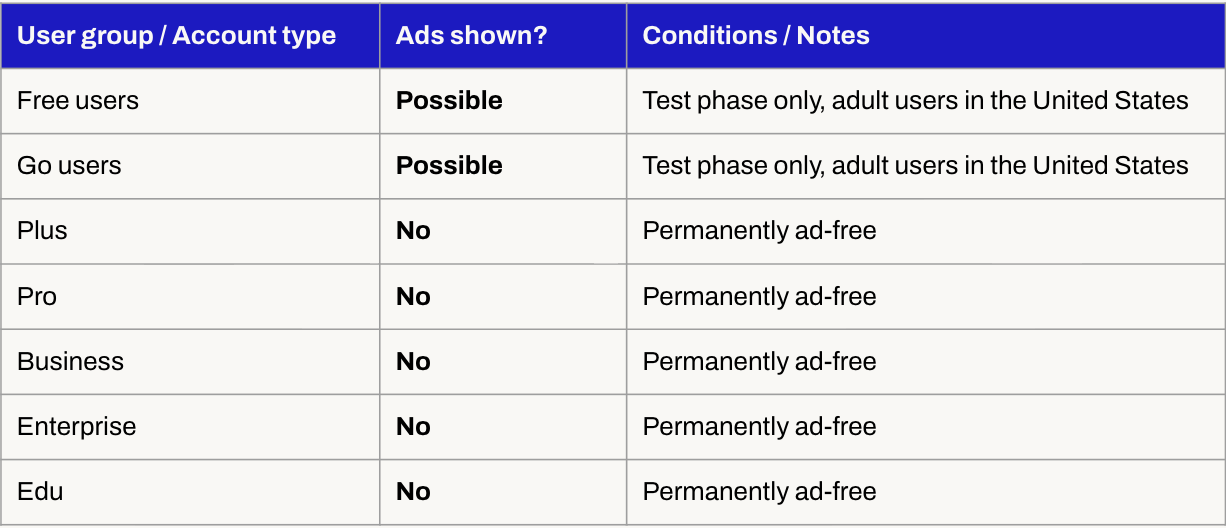
OpenAI launched a limited beta test of contextual ads in ChatGPT for Free and Plus users in the United States in early February 2026, requiring select advertisers to commit a minimum of $200,000 to participate. Users in the test may start seeing clearly labeled sponsored placements in relevant conversations. Paid tiers — including Plus, Pro, Business, Enterprise, and Edu — remain completely ad-free.
This is not a global rollout. It’s a test phase, and OpenAI is communicating the experiment clearly to participants.
Why advertising in AI is fundamentally different
Advertising in an AI environment isn’t an extension of open web display ads. It’s structurally different because ChatGPT isn’t a feed-based, scroll-driven platform.
There’s:
- No infinite scroll
- No passive consumption
- No algorithmically curated feed vying for attention
Interactions are task-driven, intentional, and inquiry based. People ask questions or set goals and expect contextual answers — not interruption.
In this context, advertising must be:
- Relevant
- Clearly separated
- Supportive of user intent, not a distraction
That changes how advertisers should think about placement, measurement, and creative.
Who Will See Ads — and Who Won’t
Seeing ads
- Free users (in the US test)
- Go users (in the US test)
Do ads influence ChatGPT’s answers?
No, ads are completely separate from ChatGPT’s responses. They do not affect how answers are generated, ranked, or phrased.
ChatGPT’s responses are optimized solely for usefulness. Any advertising content will be clearly labeled and shown outside the conversational flow.
How would ads appear?
If introduced, ads will follow three clear rules:
- Clear labeling – you will always know what is an ad
- Visual separation – ads will not be embedded in answers
- No hidden influence – conversations remain independent
The goal is transparency: no ambiguity between information and promotion.
Privacy and control
OpenAI’s advertising model, as communicated in the test, commits to:
User privacy
- Chat conversations are never shared with advertisers
- User data is not sold
- Only if a user chooses to interact with an ad (e.g., messaging an advertiser) are those explicit interactions visible to the advertiser
Control
Users can:
- Turn off ad personalization
- Hide individual ads
- Report ads
- Clear ad-related data at any time
- Upgrade to a paid plan that remains ad-free
This framework is not about maximizing attention, but about preserving choice, privacy, and transparency.
Finally, OpenAI emphasizes choice and control. Users remain in charge of their advertising experience. They can decide whether ads are personalized, clear all data used for advertising at any time, and opt for paid tiers that are completely ad-free.
Taken together, these principles point to a broader priority: long-term value over short-term revenue. ChatGPT is not optimized for time spent or attention captured. User trust and experience are treated as foundational — not trade-offs.
Why this matters for brands and platforms
Advertising inside ChatGPT is not “display ads, take two.”
It’s a search-like, intent-rich environment where:
- Reach alone isn’t the goal
- Messages must align with user intent
- Utility and context matter more than frequency
- Trust plays a foundational role in engagement
Here’s how brands should think about it:
1. Relevance over reach
Your messaging must genuinely help answer a question or solve a problem — not just interrupt.
2. Quality content matters
When a user is asking about a specific topic, brands need structured, authoritative content that matches those inquiries.
3. Prepare strategically, not tactically
This isn’t about formats yet — it’s about integration into conversational intent ecosystems.
4. Expect selectivity
Current testing is limited and invite-only. Early access is highly curated; broad self-serve ad placement is not yet available.
Want to understand what this means for your brand?
AI-driven environments like ChatGPT are reshaping how, where, and why advertising appears. Navigating this shift requires more than formats and placements - it requires a clear strategy for context, trust, and relevance.
Get in touch with us to explore how advertising can work in emerging AI contexts - without compromising user experience or brand credibility.
FAQ: Ads in ChatGPT
Are there ads in ChatGPT today — and when might that change?
Yes, OpenAI is testing ads with a select group of Free and Go users in the United States. There’s no confirmed global launch date yet.
Who would see ads, and who will remain ad-free?
Free and Go users in the US test may see ads. All paid tiers, including Plus, Pro, Business, Enterprise, and Edu, remain ad-free.
Do ads influence ChatGPT’s answers or recommendations?
No. Ads are fully separated from ChatGPT’s responses and do not affect how answers are generated, ranked, or phrased. ChatGPT continues to optimize responses solely for usefulness and relevance. Advertising content, if shown, is clearly labeled and displayed outside the conversational flow to avoid any ambiguity between information and promotion.
How is user privacy protected in an advertising model?
User conversations with ChatGPT are not shared with advertisers, and user data is not sold. If a user chooses to interact with an advertiser through an ad, only the messages sent directly to that advertiser are shared. Beyond that explicit interaction, conversations remain private and inaccessible to advertisers.
Why does advertising in ChatGPT matter for brands and platforms?
Advertising in AI environments operates under fundamentally different conditions than traditional digital platforms. There is no feed to dominate and no attention loop to exploit. Ads must coexist with moments of high intent, where trust and usefulness are critical. For brands, this raises the bar from visibility to contextual relevance. For platforms, it sets a new standard for transparency, user control, and long-term credibility.
🇨🇭TRENDBOOK 2026: The 5 Marketing Trends
Marketing is entering a new era.
The media landscape is changing faster than ever. Yesterday's strategies are no longer enough.
This Trendbook gives you the keys to transform this mutation into an opportunity.

.png)
